Enterprise AI Spending Passes $37 Billion
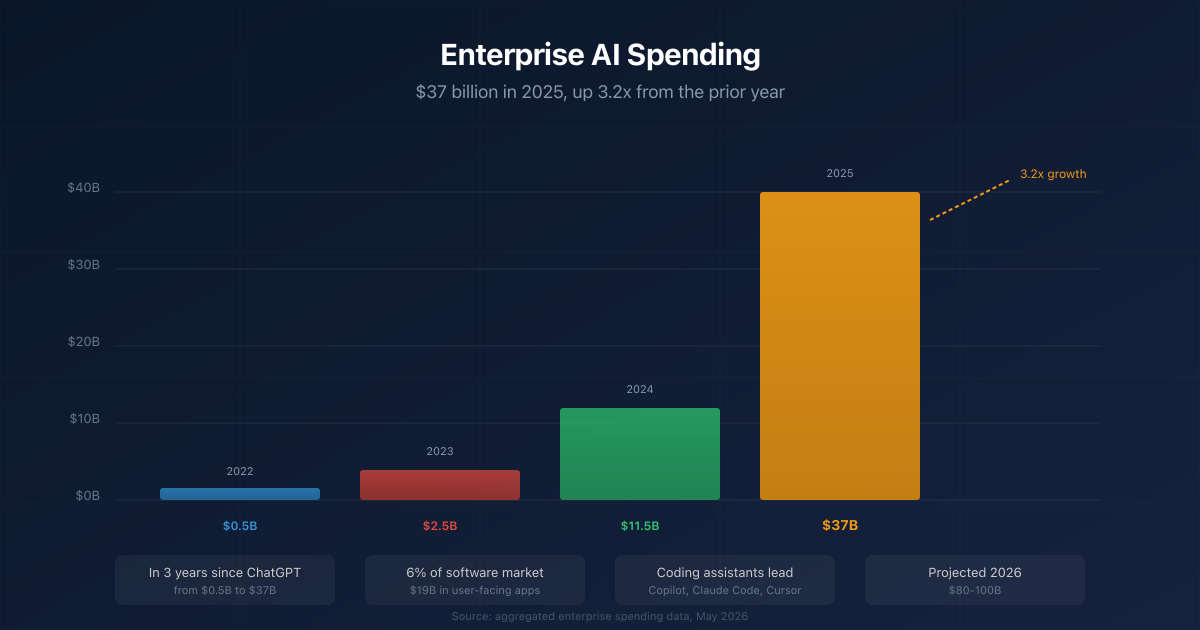
Companies spent $37 billion on generative AI in 2025, a 3.2x jump from $11.5 billion the year before. $19 billion of that went to user-facing AI applications, which now make up over 6% of the entire software market. This happened within three years of ChatGPT’s launch. The industry moved from experimentation to infrastructure faster than anyone predicted, and the numbers are finally public enough to see the shape of it.
Why $37 billion matters
The $37 billion figure comes from aggregated enterprise spending data published in late May 2026. It covers generative AI tools, models, infrastructure, and services. Not speculative investment, not venture funding rounds. Actual money companies paid for AI products they are using in production.
For context, the entire global software market was about $650 billion in 2025. AI applications claiming 6% of that in three years is unusual. Most software categories take a decade to reach that penetration. Cloud computing took about eight years to hit similar share. Enterprise AI did it in three, starting from a smaller base.
The growth is not concentrated in a single category. The $19 billion in user-facing applications includes customer support agents, coding assistants, internal knowledge tools, and content generation. The remaining $18 billion covers model inference, training, fine-tuning infrastructure, and custom deployments. Both sides grew at roughly the same rate.
What enterprises are actually buying
The spending data tells a story about what works in production. Three categories account for most of the budget.
Coding assistants lead the pack. GitHub Copilot, Claude Code, Cursor, and similar tools are the most deployed AI products in enterprise environments. The ROI is measurable: shorter cycle times, fewer context switches, faster onboarding. Engineering organizations tend to be the first adopters because they can evaluate code output directly without waiting for qualitative metrics.
Customer support agents are the second largest category. Companies are deploying conversational AI for front-line support, routing, and triage. The technology has reached the point where well-tuned agents handle 60-80% of tier-1 questions without escalation. The savings are visible in headcount allocation and response time metrics.
Internal knowledge tools round out the top three. Search augmented with generative responses, document summarization, compliance checking. These are less visible than customer-facing products but generate consistent savings across large organizations.
The common thread is that every category replaces or augments an existing cost center. Companies are not buying AI because it is exciting. They are buying it because it reduces a specific line item on the budget.
Where the money goes in the stack
The $37 billion splits roughly in half. About $19 billion went to AI applications like coding assistants, support agents, and knowledge tools. The other $18 billion went to infrastructure: model API calls, compute, training, and the tooling that makes deployment possible.
Infrastructure is the hidden growth story. Companies are discovering that raw model access is not enough. You need prompt management, guardrails, evaluation pipelines, logging, and cost tracking before you can run an AI feature in production safely. The tooling layer around models is growing faster than the models themselves.
Why this is different from the VC spending narrative
Venture capital investment in AI startups has been breaking records throughout 2025 and 2026. OpenAI raised $110 billion at an $840 billion valuation. Anthropic just closed a $65 billion round at $965 billion. These numbers dominate headlines, but they describe the supply side. The $37 billion enterprise spending number describes demand.
The two are related but not the same. VC money funds model development, research, and infrastructure buildout. Enterprise spending funds deployment, integration, and usage. The VC story is about who will own the next platform. The enterprise spending story is about who is actually using AI today.
The gap between them is narrowing. When enterprise AI spending reaches a scale where it sustains the companies burning VC capital, the industry passes a milestone. At $37 billion in 2025 growing to a projected $80-100 billion in 2026, that crossover is in sight. Anthropic’s first operating profit, reported the same week as the spending data, is the first signal that the math is starting to work.
What this means for developers
If you build AI products or work with AI platforms, the enterprise spending shift matters more than any model benchmark.
First, the API calls you make at $0.003 per thousand tokens are subsidized by enterprise contracts that pay ten times that for the same model. Consumer pricing is enterprise-funded. That is not going to change soon because the enterprise pipeline is where the revenue is.
Second, the tooling layer is the growth market. The value is not in being yet another model provider. It is in the logging, evaluation, guardrail, and orchestration software that makes models safe to run in production. Enterprises will pay more for a reliable evaluation framework than for a marginally better model.
Third, the integration cost is the moat. The infrastructure half of the $37 billion is sticky. Once a company has built prompt management, evaluation pipelines, and compliance monitoring around one model provider, switching costs are high. That is why the model race matters less than it looks. The winner is not the best model. It is the platform enterprises have already wired into their stack.
The regulatory backdrop
The enterprise spending surge is happening alongside a regulatory shift. In late May 2026, the Trump administration scrapped a proposed AI executive order after lobbying from tech leaders. The reported rationale was competitiveness. The practical effect is that US enterprises face fewer compliance mandates than their European counterparts for the near term.
This matters for spending forecasts. Enterprises that were holding back on AI deployment due to regulatory uncertainty now have a clearer path. The $37 billion figure includes a regulatory-risk discount that is starting to lift.
What happens next
The 3.2x growth rate will not hold forever. The easy deployments are happening first: coding assistants, customer support, internal search. The harder deployments require workflow redesign, data migration, and organizational change. Those take longer but represent more spending.
The 2026 projection of $80-100 billion in enterprise AI spending assumes the easy category saturates and the hard category starts to deploy. If the hard category moves faster than expected, the number could hit $120 billion. If regulatory friction or model limitations slow things down, it might land closer to $70 billion.
Either way, the direction is clear. Enterprise AI spending is not a hype cycle. It is a structural shift in how software is bought and sold.
Frequently asked questions
How is enterprise AI spending measured?
The $37 billion figure aggregates spending on generative AI tools, models, infrastructure, and services from public company filings, procurement surveys, and analyst estimates. It includes API usage, custom deployments, and the tooling layer around models. It excludes internal R&D costs and VC investment.
What is the biggest category of enterprise AI spending?
Coding assistants and developer tools are the largest category, followed by customer support agents and internal knowledge tools. Together they account for more than half of the $37 billion. The common factor is measurable ROI: shorter development cycles, lower support costs, and faster information retrieval.
Is enterprise AI spending growing faster than VC investment in AI?
They are growing at different rates from different bases. Enterprise spending grew 3.2x from 2024 to 2025. VC investment in AI also grew but fluctuates more by quarter because it depends on mega-rounds. Enterprise spending is more predictable and better correlated with actual usage.
How does regulation affect enterprise AI spending?
Regulatory uncertainty was a headwind through 2024 and early 2025. The late May 2026 decision to scrap a proposed AI executive order in the US removed some of that friction. European enterprises face a different regulatory environment with the EU AI Act, which may slow adoption in regulated industries.
What happens when the easy enterprise deployments are done?
The second wave of enterprise AI deployment involves workflow redesign, custom model tuning, and integration with legacy systems. These projects are more expensive, take longer, and require organizational change. They also represent a larger addressable market. The $80-100 billion projection for 2026 assumes this wave begins in earnest.