EU AI Act Voice Watermarking: What TTS Builders Must Know
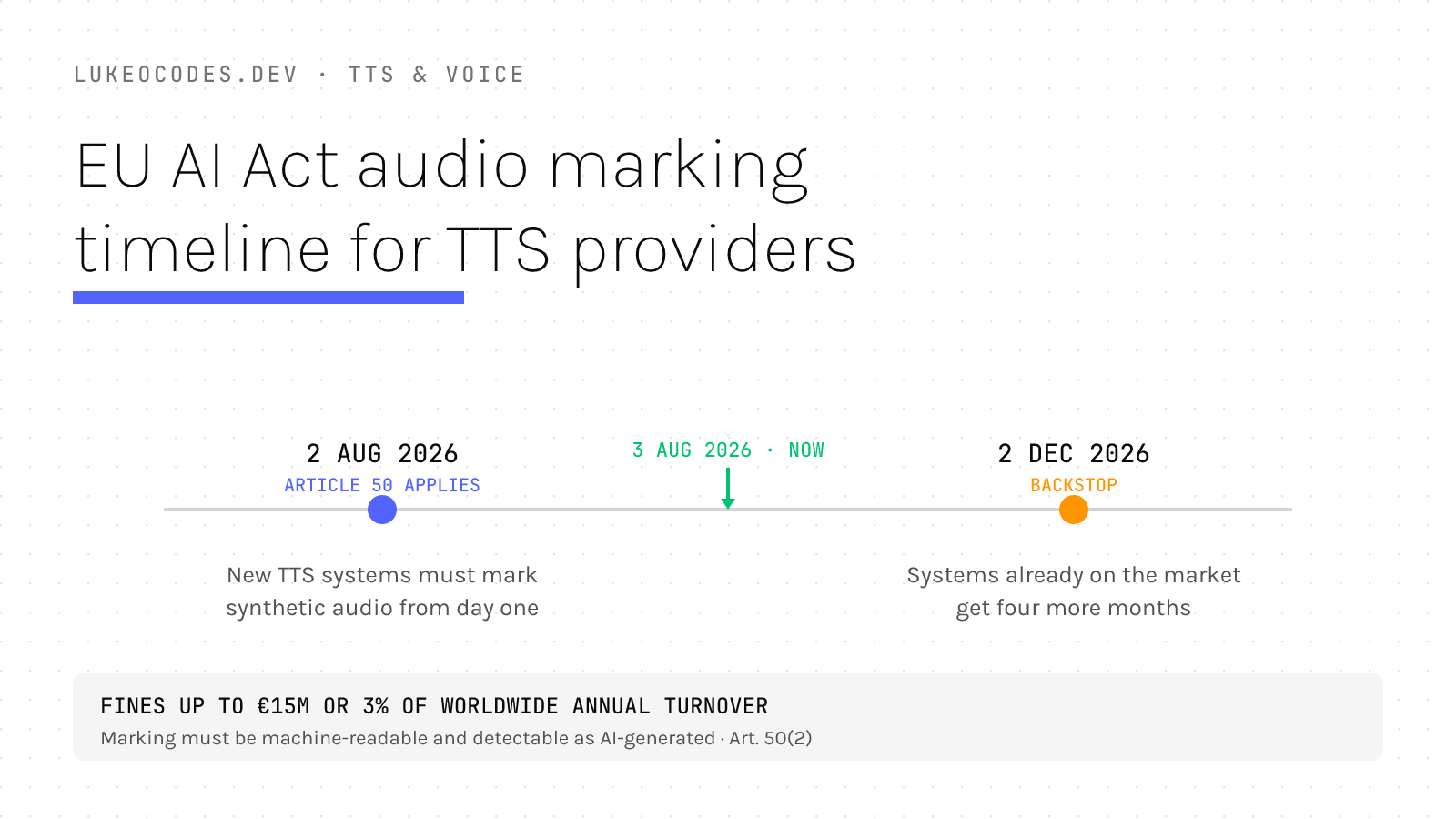
The EU AI Act voice watermarking rules took effect on August 2, 2026. Every AI system that generates synthetic audio, image, video or text must now mark its output in a machine-readable format that can be detected as artificially generated, and the fines for missing it run to EUR 15 million or 3% of worldwide annual turnover. If you build on a TTS API or run a voice agent for EU users, the marking duty sits with your provider, but the compliance risk lands on your product.
What does the EU AI Act require for AI audio?
Article 50 of the EU AI Act covers transparency for generative AI, and the part that matters for voice is Article 50(2). Providers of AI systems that generate synthetic audio must ensure the output is marked in a machine-readable format and detectable as artificially generated or manipulated. That covers text-to-speech output, voice clones, AI dubbing, and general-purpose AI models with audio generation.
The obligation is outcome based. The law does not name a specific watermarking technology. It requires the marking to be effective, interoperable, robust and reliable, as far as this is technically feasible. The phrasing matters, because audio is harder than images. Most providers are settling on a layered approach: an inaudible watermark embedded in the signal plus signed provenance metadata.
Two related duties sit nearby. Any AI system that interacts with people, including voice bots, must tell the user they are talking to an AI. Deployers must also disclose deepfakes: AI audio or video that resembles a real person and could pass as authentic. If you run a voice agent, you can hit all three at once.
The European Commission adopted its Article 50 guidelines on July 20, 2026, and the accompanying Code of Practice on transparency of AI-generated content sets out how providers can demonstrate compliance. By the end of July, about 190 companies and organisations had signed up. Signatories can lean on the code as the EU-wide recognised framework for showing they meet the marking and labelling obligations. Non-signatories have to convince each market surveillance authority on the merits.
When does the EU AI Act voice watermarking deadline hit?
The transparency obligations apply from August 2, 2026 to every system in scope. There is one grace period: providers of generative AI systems already on the market before August 2 have until December 2, 2026 to bring their Article 50(2) marking into line. Anything new launched from August 2 must comply from day one. Content generated and published before August 2 does not need retroactive marking.
That backstop is worth taking literally. A provider that ships watermarking in November can call itself compliant. One that treats December 2 as a suggestion is betting on being the last unmarked TTS vendor standing when a market surveillance authority comes knocking. I would not take that bet.
Which AI voice systems are exempt from audio marking?
The exemption is narrower than most people hope. Article 50(2) does not apply to AI systems performing an assistive function for standard editing that do not substantially alter the input or its semantics. Noise reduction, EQ, de-reverb, pitch correction that preserves the original speaker. That is the whole practical exemption.
In scope: any TTS system generating full narration, voice cloning tools, AI dubbing that changes speaker identity, and general-purpose models with audio generation. If your product synthesizes speech from text or replicates a voice, you are covered. The creative exemption for artistic or satirical work applies to how the content is used, not to the provider’s marking duty, so do not assume it lets you skip the watermark.
How do TTS providers watermark AI audio?
Three approaches dominate in 2026, and most serious providers use more than one.
SynthID Audio from Google DeepMind embeds an inaudible watermark in the waveform. It survives ordinary re-encoding and compression, which is what makes it useful, because audio rarely travels as a pristine WAV. Google applies it automatically to supported voices on Google Cloud TTS.
AudioSeal from Meta is the open-source option. It is a perceptual audio watermarking library, MIT licensed, with a 16-bit message payload and detection at segment level rather than full-file. If you need to watermark audio inside your own pipeline, this is where most teams start.
C2PA Content Credentials take a different route: cryptographically signed metadata attached to the file that records what generated it. C2PA is rich but strippable. A re-encode or a screen recording can drop the metadata while the watermark survives, which is exactly why the two are complementary rather than competing.
How can developers verify AI-generated audio?
OpenAI made the first big verification move. On July 31, 2026, it started embedding SynthID watermarks in all GPT-Live audio, across ChatGPT Voice and the API. GPT-Live replaced Advanced Voice Mode on July 8. Alongside the watermark it opened a content provenance API, POST /v1/content_provenance_checks, so any developer can run provenance checks in their own pipeline instead of uploading files to a web tool.
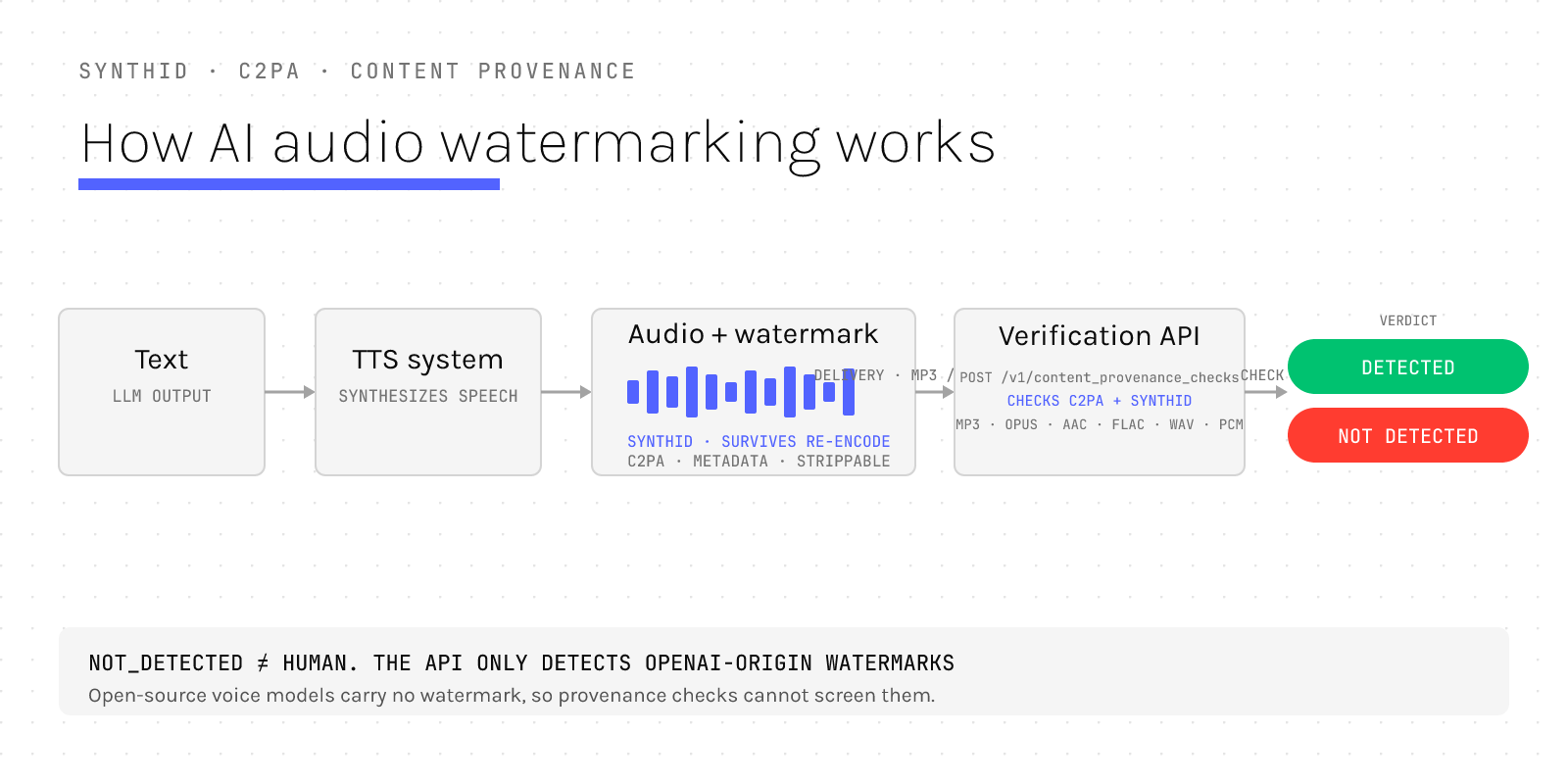
The API checks images and audio. For audio it looks for a SynthID watermark and accepts MP3, Opus, AAC, FLAC, WAV and PCM, with a 50 MiB file limit. The full endpoint reference is worth a read, but the honest limits matter more than the mechanics: it only detects OpenAI-origin signals, and a not_detected result does not mean the audio is human. It means OpenAI’s watermark is absent, which could be because the audio came from another vendor, from an open-source model, or from something whose watermark was stripped.
That last case is the structural gap. Open-source voice models carry no watermark at all, so no provenance-based system can screen them. A voice clone made with an open model is indistinguishable from a human recording to every detector that exists. Regulation can mandate marking. It cannot invent detection where the generator left nothing to find.
What should voice app developers do before December 2?
The EU AI Act voice watermarking requirements changed what compliant means, and four checks cover most of the work. I would do them in this order.
First, audit your audio outputs. Which of your systems synthesize speech, clone voices, or dub content? If you build on a TTS API, the marking duty sits with the provider, and the contract should say so. Ask your vendor which voices carry compliant watermarks and when the coverage lands.
Second, verify the watermarks survive your delivery pipeline. If you transcode, resample, or normalize audio before it reaches users, test that the marking survives. A provider can be compliant at the source and useless by the time your product ships it. Your transport matters too. A streaming session that plays back chunk by chunk still needs the marking present in the audio your users receive, so test the same path end to end, not the source file in isolation.
Third, sort out the disclosure side. If your product is a voice agent, users must be told they are talking to an AI. If it publishes audio that resembles a real person, the deepfake disclosure applies. These are deployer duties and they do not vanish because the provider marks the audio.
Fourth, keep generation records. The Commission’s code and the market surveillance expectations point the same way: you should be able to show which generation method was used, which key version signed it, and when. A compliance log is cheaper than an explanation after the fact.
The four-month backstop changes the shape of this work. Providers that ship marking before December 2 set their own pace. Everyone else gets a deadline instead of a schedule. This is the second layer of synthetic voice rule-making I have written about this year, and the first one with fines attached. The first wave arrived from three directions at once: platform policy, publicity rights, and copyright law, and I covered all three a few weeks back. This time the EU added a compliance layer with real teeth.
Frequently asked questions
Is AI voice watermarking required by law in the EU?
Yes, from August 2, 2026. The EU AI Act voice watermarking rules require providers of AI systems that generate synthetic audio to mark output in a machine-readable format detectable as artificially generated. Systems already on the market before August 2 have until December 2, 2026. Fines for non-compliance reach EUR 15 million or 3% of worldwide annual turnover.
Does the EU AI Act apply to TTS APIs?
Yes. Any provider offering text-to-speech, voice cloning, or AI dubbing to the EU market is a provider of a generative AI system under Article 50. The marking duty sits with the provider, not the developer who calls the API. Deployers must not strip watermarks and must handle user-facing AI disclosure.
Can SynthID watermarks be detected in audio?
Yes. SynthID audio watermarks are embedded in the waveform and survive common re-encoding like MP3 and AAC. OpenAI’s content provenance API, POST /v1/content_provenance_checks, returns a detection result for supported audio files. Detection is limited to signals the provider embedded, and a not_detected result does not prove the audio is human.
What happens if a TTS provider does not watermark audio?
The provider faces fines of up to EUR 15 million or 3% of worldwide annual turnover, enforced by national market surveillance authorities. Deployers who integrate an unmarked provider take on the risk, so most are adding contractual clauses that require compliant marking and prohibit stripping it.
Are open-source TTS models covered by the EU AI Act?
The marking obligation applies to providers who place the system on the EU market. An open-source model in itself carries no watermark, and open-source voice cloning currently cannot be detected by provenance systems. That gap is structural: regulation can mandate marking, but it cannot detect audio that was generated without any signal to find.