Kimi K3 Weights Drop as Washington Argues Distillation
Moonshot AI releases the weights for Kimi K3 today. Bloomberg’s coverage has the numbers: 2.8 trillion parameters, a one-million-token context window, the largest open-weight model anyone has ever shipped. Anyone with the hardware can download it, tweak it, and host it from this afternoon. And in the seven days leading up to that release, the US government floated a ban on Chinese open models, threatened sanctions over IP theft, and publicly accused Moonshot of building K3 by distilling Anthropic’s Fable.
That sequence is the story. Not the model, the reaction to it.
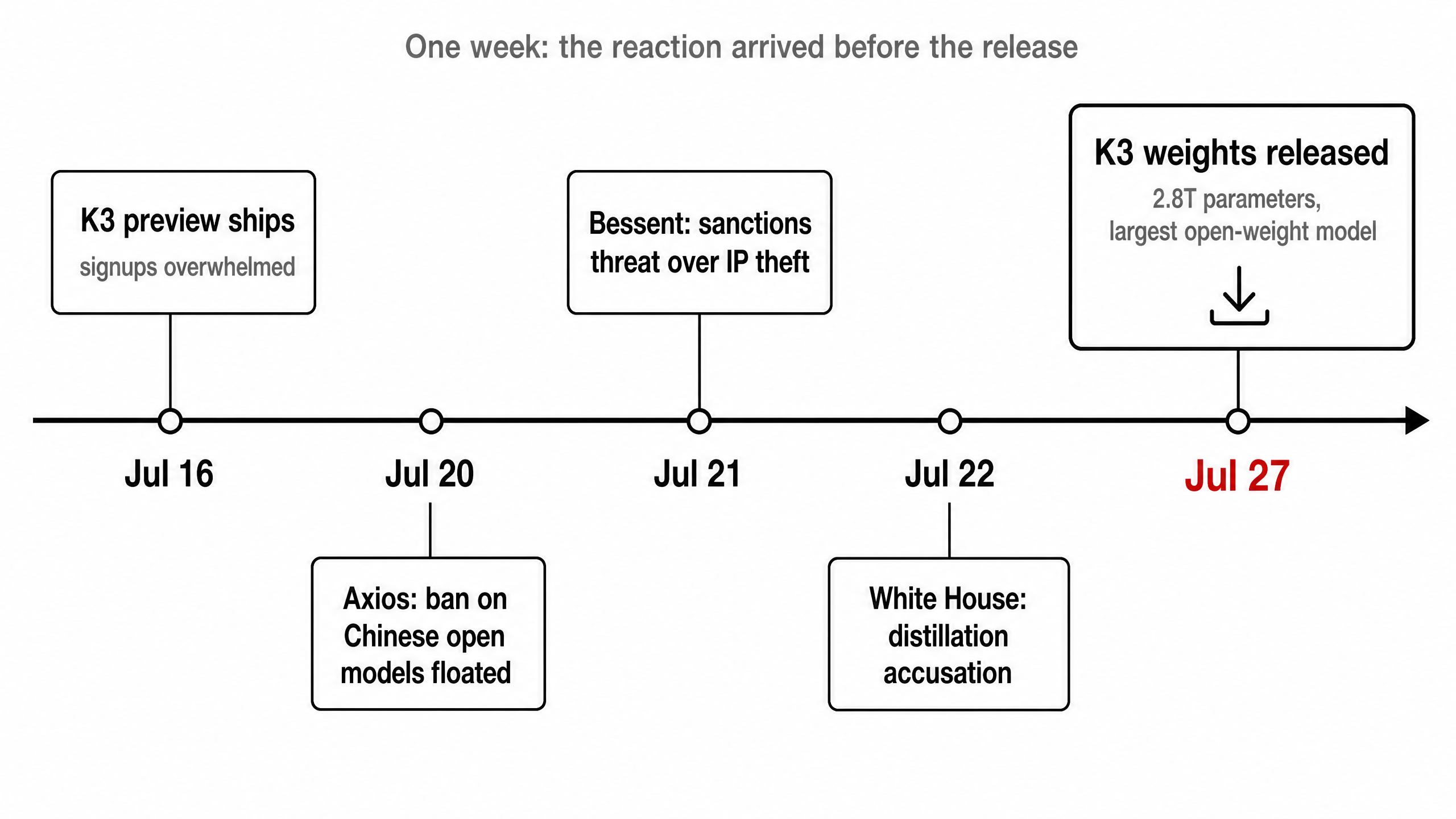
Quick recap of the week, because it was genuinely busy. Monday, Axios reported that the administration is showing signs it could ban cutting-edge Chinese AI models, with sources describing Entity List discussions and draft supply-chain rules that had been killed before and are now back on the table. Tuesday, Treasury Secretary Scott Bessent went on Fox Business and said the US would examine Chinese open models for signs of IP theft, with sanctions available if it finds any. Wednesday, White House OSTP director Michael Kratsios posted that “we have information that Moonshot AI distilled Anthropic’s Fable for the development of its K3 model”, alongside a claim that Moonshot trained on export-restricted GB300 servers accessed through Thailand. Thursday, TechCrunch rounded up the experts, who were sceptical. And today the weights land anyway.
Is the distillation accusation actually true?
Partially, probably. But the part that’s probably true doesn’t support the conclusion being built on it.
Anthropic published detailed evidence in the spring that Moonshot, DeepSeek, and MiniMax ran industrial-scale extraction campaigns against Claude: over 16 million exchanges across roughly 24,000 fraudulent accounts, with Moonshot’s share at 3.4 million exchanges attributed through request metadata that matched the public profiles of senior Moonshot staff. That’s real evidence, published with methodology, and I don’t see a good reason to doubt it. Chinese labs have been mining frontier model outputs at scale. Everyone in the industry knows this.
The specific claim Kratsios made is different, and weaker. Fable has only been publicly available since July 1. K3 shipped its preview on July 16. Braden Hancock’s response in the TechCrunch piece is the one that stuck with me: “You can’t distill that much data, train a model, and release it in two weeks.” Nathan Lambert made the more structural point, which is that distillation buys you less and less as training shifts to reinforcement learning. Supervised fine-tuning on another model’s outputs teaches your model its manners, as Lambert puts it. It doesn’t get you a 2.8 trillion parameter model that ranks third on Artificial Analysis’s intelligence index and first on Arena AI for web development. If distillation alone got you that, every lab with API access would be at the frontier, and they are not.
So the honest version of the claim is something like: Moonshot has previously extracted Claude outputs at scale, in violation of Anthropic’s terms, and some of that material may be somewhere in K3’s training lineage. That’s a terms-of-service dispute and possibly a trade one. What it isn’t is an explanation for why K3 is good.
The awkward argument underneath
Here’s where I lose sympathy with the Washington framing entirely. The US frontier labs trained their models on the open internet. My code, your blog posts, millions of copyrighted books. Anthropic just got court approval on July 20 to start paying out a $1.5 billion settlement for illegally downloading and storing exactly those books. That happened the same week as the sanctions threats, and almost nobody put the two stories next to each other.
Satya Nadella did, more or less, earlier this month: he finds it ironic that labs claiming fair-use rights to train on everyone’s public data turn around and impose restrictive terms on distillation of their own outputs. Elon Musk testified in April that xAI distilled OpenAI models and that the practice is common across the industry. Hugging Face’s Clem Delangue called distillation “a very small factor” that “everyone is doing, including companies in the U.S.” The line between distillation and building a synthetic dataset is blurry enough that Musk could say it under oath without anyone gasping.
The principle on offer is: training on the whole world’s output is innovation, training on our output is theft. I understand why a lab whose valuation depends on a capability moat would argue that. I don’t understand why anyone else would accept it at face value.
Why the timing tells you what this is really about
If K3 were a security threat, the reaction would have started when the preview shipped on July 16 and benchmarks landed. It didn’t. It started when K3’s ranking made it obvious the model was commercially competitive with Fable and GPT-5.6, and it escalated all week as the weights release approached. Meanwhile, daily sales at Moonshot are up at least sixfold since the K3 debut and the company is raising at a $50 billion valuation. The threat being responded to is a business threat.
David Sacks, hardly a China dove, said the quiet part on X: “The leading closed labs, already a duopoly in terms of AI model revenue, want the government to eliminate their open-source competition.” One of Axios’s sources described labs or their allies approaching the administration “every 3-5 months with an idea to ban open-source models”. You can believe Chinese labs behave badly (I do) and still notice that the policy response is being drafted to the specification of the companies that benefit from it.
And the closed labs are already living with the consequences of inviting government into the release process. Anthropic got a letter at 5:21pm on a Friday ordering it to restrict Fable 5 and Mythos, on the strength of what the company says was verbal evidence of one narrow jailbreak, and pulled the models for every customer to be safe. OpenAI is staggering GPT-5.6’s release through a government-approved customer list under a “voluntary” process it clearly does not consider voluntary. Ask for a moat, get a landlord.
Can you actually stop an open-weight release?
This is the practical question and the answer is mostly no, which is why the week’s activity reads as theatre. Sanctions can hit Moonshot’s revenue and its Hong Kong IPO ambitions. Procurement rules can stop US agencies deploying K3. What none of it can do is un-distribute a weights file. Once 2.8 trillion parameters are on Hugging Face mirrors and a few thousand torrents, the capability is out, permanently, for everyone including the people sanctions are aimed at. Bay Area researchers were already running GLM 5.2 in their daily workflows weeks after its release. The users you can actually pressure are American companies, and pressuring them just means they do the same work with a worse model or a VPN.
There’s a real cost argument for scepticism about K3 that has nothing to do with Washington, by the way. Dean Ball, who recently joined OpenAI, called K3 “very token-hungry” and noted the per-token price advantage shrinks if the model needs more tokens to finish the same job. Worth testing before you re-platform anything. But that’s an engineering evaluation, and you can run it yourself this afternoon, which is rather the point of open weights.
I said in my open-weights piece last week that open models have caught the frontier in text while staying well behind in speech. Nothing about this week changed either half of that. What changed is that the US government now treats a weights file as an event requiring a policy response, and the policy response on offer is to protect two companies’ revenue with export law. That trade is bad even if you like the two companies.
The weights are out today. The technical report is coming. Read that instead of the tweets.
FAQ
What is Kimi K3 and why does its release matter?
Kimi K3 is a large language model from Beijing-based Moonshot AI. Its weights were released for public download on July 27, 2026, making it, at 2.8 trillion parameters with a one-million-token context window, the largest open-weight model ever published. It ranks third on Artificial Analysis’s intelligence index and first on Arena AI’s web development leaderboard, close behind closed frontier models like Anthropic’s Fable and OpenAI’s GPT-5.6.
Did Moonshot AI really distill Anthropic’s Fable to build K3?
The White House says it has information that it did, but has published no evidence. Anthropic has separately documented large-scale extraction campaigns by Moonshot against earlier Claude models, so prior distillation is well supported. Researchers are sceptical about Fable specifically: it was only public for two weeks before K3’s preview shipped, which is not enough time to distill, train, and release a model of this scale.
Is model distillation illegal?
No law clearly prohibits it. Distillation typically violates a provider’s terms of service, which is a contract matter, not a crime. It is also common practice: labs distill their own models routinely, and Elon Musk testified in 2026 that xAI distilled OpenAI’s models. The US is now exploring whether sanctions law can be applied to foreign labs that do it, which would be a significant escalation.
Can the US government actually ban an open-weight model?
It can make one commercially radioactive: Entity List designations, procurement bans, and pressure on US companies that host or build on it. It cannot recall the file. Once weights are downloadable, they persist on mirrors and torrents worldwide, so a ban mostly affects law-abiding US companies rather than the adversaries it targets.
Does the K3 release affect voice AI and text-to-speech?
Not directly, K3 is a text model. Open weights in speech still trail the closed frontier badly: the best open TTS model sits more than 100 Elo points behind closed leaders like Speechify’s Simba 3.2 on the blind-vote Speech Arena, a gap listeners can hear. If open speech models ever close that gap the way K3 closed the text gap, expect the same policy fight to follow the audio.