The Attribution Paradox: Measure Before You Scale
The attribution paradox: the moment a developer platform becomes someone’s full-time job, the job stops having time to measure whether the platform works.
When a business launches a public API or a developer platform, the early phase is all execution. Portals to design, SDKs to build, self-serve onboarding to smooth, early partners to integrate. For a lean team, that phase feels like a sprint. Every signed partner and shipped endpoint reads as a milestone.
It is a trap. A team that spends 100% of its resources on execution and 0% on attribution infrastructure builds a structural deficit, quietly, in the middle of all that momentum. No data loop ties developer activity to business outcomes, so the platform reads internally not as a growth engine but as an open-ended experiment. The 2025 State of the API report from Postman found 65% of organizations now generate revenue from their APIs, and three quarters of those generate at least 10% of total revenue from them. Platforms are revenue engines. But an engine with no instrumentation gets treated like a research project.
The way out is to resolve the attribution paradox: protect the time to measure value before you exhaust your capacity trying to scale it.
Why does a new platform team become an organizational sponge?
A developer ecosystem does not fit the corporate structure it launches inside, especially in a business built on a consumer product or a traditional sales motion. An API platform is simultaneously a product, a marketing channel, an engineering infrastructure, and a business development lever. Because it touches every department, an unmanaged platform team becomes an organizational sponge, absorbing whatever cross-functional responsibility has no clear owner.
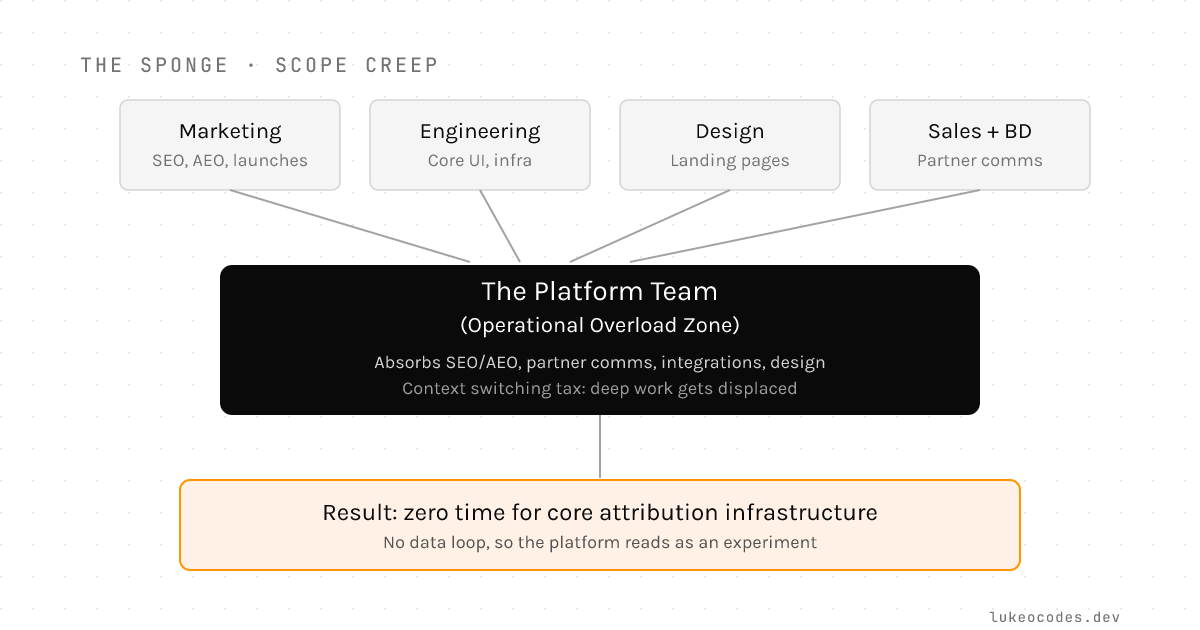
Three absorption points show up almost immediately:
- Product marketing dilution. Technical SEO and AEO, landing pages, launch branding. Core marketing teams are built for mainstream buyers, not technical audiences, so platform content quietly becomes the platform team’s job.
- Solutions architecture overload. Bespoke integration code, per-customer pipeline troubleshooting. There is no technical partner engineering team yet, so the platform team writes the glue and debugs the edge cases.
- Relationship management. End-to-end partner communication lands on the team. Scalable developer relations becomes manual account management, one Slack thread at a time.
The cost is not the hours. The cost is context switching. Deep work gets displaced by transactional work, and the transactions always win because they arrive with someone attached. I have written before about how a streaming API’s real surface area shows up in the integrations you have to hold together, and this is the organizational version of the same problem.
Here is the irony that should keep platform leads up at night. The work required to keep the platform running is the exact work that prevents the team from building the telemetry that proves why it should exist. The team is too busy being the sponge to build the case that would let it stop.
What happens when leadership calls the platform an experiment?
In corporate governance, classification determines funding. When a platform is referred to internally as an experiment, it signals that leadership is testing a hypothesis rather than committing to permanent infrastructure. Experimental projects get agility. They also get no headcount, no multi-year budget, and no seat at the planning table.
The mismatch is structural, because developer platforms do not adopt like software features. An external engineer has to spend their own resources reading your docs, testing your endpoints, writing code, and shipping an integration to their own end users. That is a multi-month lifecycle at best. The State of the Platform Economy 2026 frames platform value as network effects, where value increases with participation on both sides. Network effects compound slowly, then suddenly. An experiment’s operating cadence cannot see them.
| Vector | The core business mindset | The developer platform reality |
|---|---|---|
| Success metrics | Rapid A/B testing, short-term engagement spikes | Multi-month integration cycles, compounding network effects |
| Operational focus | Fast feature shipping, consumer iteration | API stability, backward compatibility, long-term trust |
| Resourcing | Lean until immediate product-market fit | Upfront investment in docs, tools, analytics |
The consequence of the mismatch is the trust cliff. External developers can smell a temporary experiment, and they will not build a product on one. Trust is the primary currency of the developer economy. Developers remember platforms that blindsided them, and they price the risk of a platform vanishing into every integration decision they make. As the API evangelist community puts it: your API terms are a promise about your future behavior, and people are pricing your trustworthiness whether or not you are managing it.
To shed the experimental label and earn permanent commitment, the platform team needs undeniable data. And if the team is buried under the sponge work, it can never build the pipelines that produce that data. The label becomes self-fulfilling.
Why is scaling before attribution a structural deficit?
From an executive viewpoint, an unmeasured channel is an unsuccessful channel. A balance sheet shows the platform’s cost as human hours. If nothing ties those hours back to business value, the natural response is to cap investment or wind the project down. 2026 is the year platform teams must prove value or lose funding: Gartner’s forecast of 80% of software organizations running platform teams by 2026 means platforms are no longer special initiatives. They are line items, reviewed the way every other line item is reviewed.
Deferring attribution in favour of “just getting things done” creates three systemic risks:
- The valuation vacuum. A platform can drive substantial indirect value: retention, churn reduction, new acquisition channels. If those metrics are never captured and mapped to the platform, that value defaults to zero in the eyes of stakeholders. This is the core caveat in platform ROI work: value that looks like friction that did not happen is real, but it is worthless in a budget review unless someone quantified it.
- The inefficient scaling trap. Without attribution data, nobody knows which developer segments or integrations actually move business levers. The team optimizes the loudest partner instead of the most valuable one, and spends scarce capacity on features with no measurable return. Teams that measure a single metric have about a one-in-three chance of platform success; teams that measure six or more dimensions across velocity, quality, experience, and business value succeed most often. More dimensions, not fewer, is the defensible posture.
- The trust cliff. If a platform is wound up because nobody could see its ROI, the company deprecates live public APIs and strands every partner that built on them. Network effects are responsible for roughly 70% of the value created by technology companies since 1994. Burning a network’s trust is not a small incident. It is a long-term deficit in a market where your future partners were already nervous.
The paradox closes here. The teams most at risk of being wound down are the ones that never got the chance to build the measurement that would have saved them. And the measurement work was always the first thing deferred, because it has no external customer and no shipped endpoint.
How do you reset a platform team to prioritize telemetry?
The reset is a realignment on a core principle: instrumentation is not a post-launch optimization. It is a launch requirement. The distinction matters because it changes where the work goes in the plan, and where it goes determines whether it survives contact with the partner pipeline.
Three operational shifts get a platform team from deficit to sustainable growth model.
1. Draw ruthless scope boundaries
A lean platform team cannot be the permanent safety net for cross-functional gaps. Every task needs an audit and an aggressive handoff to its rightful owner the moment a basic framework exists.
- Partner communication belongs to business development or account management, not DevRel.
- Core UI/UX and infrastructure design belongs to central engineering and the design org.
- Platform DevRel focuses only on scalable levers: documentation, foundational developer tools such as CLIs and Model Context Protocol integrations, and ecosystem analytics.
The goal is not to refuse work. The goal is to refuse work that another team is structurally responsible for, so the platform team keeps the capacity that its actual mandate requires.
2. Establish the value baseline before scaling
Before expanding the partner pipeline or the API surface, stop feature work and build the baseline data loop. Build telemetry that shows how a developer’s API call or an external integration translates into core business value, whether that value is user acquisition, API data volume, or ecosystem-driven retention.
The pipeline has to be automated, verifiable, and transparent to executive leadership. This is the same discipline Stripe applies to outcome-based pricing: instrument the product so every outcome unit is logged as it happens, then decide how credit is assigned when multiple factors contribute. If the data pipeline depends on a senior engineer manually stitching spreadsheets every quarter, it will not survive the first roadmap crunch. If it runs automatically and feeds the board deck, it becomes infrastructure that protects the platform.
Attribution in developer relations is genuinely hard, and it is worth being honest about that. The 2025 State of Developer Adoption report found 76% of developer-focused companies struggle with multi-touch attribution, because developers arrive through blogs, GitHub repos, docs, and community threads that classic marketing attribution does not track. The answer is not a perfect model. It is first- and last-touch signals, UTM parameters, referrer data, and signup surveys, combined into a directionally correct picture that holds up in a quarterly review.
3. Treat attribution as a non-negotiable product feature
If an API endpoint or a partner integration cannot be tracked, it is incomplete. Ship attribution alongside the feature, the way you ship error handling and tests. Treating attribution as an absolute prerequisite changes the culture from a race for raw output to a discipline of measurable outcomes.
This is the same principle behind the design decisions that make a voice API usable: the API design choices that shape developer experience are never bolt-on extras, they are part of the contract. Attribution is part of the contract too. An endpoint without telemetry is an endpoint whose business case is already in dispute.
What does running a platform team blind actually cost?
Run a platform team lean and you manage early-stage risk. Run it blind and you accept an existential hazard, because you have handed the decision about your platform’s future to whoever reads the cost column without the value column.
The path to a thriving, permanent developer ecosystem is not doing 20% of every job in the company to keep a platform afloat. It is firm operational boundaries, non-core tasks handed off to their rightful owners, and aggressive prioritization of the attribution infrastructure that proves the platform’s worth in the language leadership already understands.
The paradox resolves in one direction only. Measure the value before you scale the scope, or the scope consumes the capacity that measuring requires.
FAQ
What is the attribution paradox?
A platform team that spends all its resources on execution and none on attribution gets read internally as an experiment rather than a growth engine. Leadership then winds it down for lack of proof, which strands every partner that built on it. The resolution is to protect time for measurement before spending capacity on scale.
Why do platform teams stop measuring as they grow?
Scope creep is the mechanism. An API platform touches marketing, engineering, design, and business development at once, so an unmanaged team absorbs every unassigned cross-functional task. Context switching displaces deep work, and the transactional work always wins. The team becomes too busy keeping the platform alive to build the telemetry that proves it should exist.
How do you attribute developer activity to business outcomes?
Combine first- and last-touch signals: UTM parameters, referrer data, documentation page signups, GitHub repo links, community threads, and signup surveys. The 2025 State of Developer Adoption report found 76% of developer-focused companies struggle with multi-touch attribution, so the goal is a directionally correct picture that survives a quarterly review, not a perfect model.
Who should own partner communication on a platform team?
Business development or account management. A platform DevRel team should focus on scalable levers: documentation, foundational developer tools such as CLIs and MCP integrations, and ecosystem analytics. When DevRel owns end-to-end partner communication, it becomes manual account management and loses the capacity for scalable developer relations.
What happens if a platform is wound down without attribution data?
The company deprecates live public APIs and strands every partner that built on them. Developers remember platforms that blindsided them, and they price that risk into every future integration decision. The trust deficit is long-term and very hard to repair, which is why the valuation vacuum is so dangerous: unmeasured value defaults to zero in a budget review even when the platform is genuinely driving retention, acquisition, and network effects.
References
- Postman, 2025 State of the API Report: https://voyager.postman.com/doc/postman-state-of-the-api-report-2025.pdf
- Platform Executive, State of the Platform Economy 2026: https://www.platformexecutive.com/insight/technology-research/state-of-the-platform-economy-2026
- Platform Engineering, Measuring the ROI of platform engineering investments: https://platformengineering.org/blog/measuring-the-roi-of-platform-engineering-investments
- Byte Iota, Platform engineering ROI 2026: prove value or lose funding: https://byteiota.com/platform-engineering-roi-2026-prove-value-or-lose-funding/
- Shno, Network effect statistics for 2026: https://www.shno.co/marketing-statistics/network-effect-statistics
- Stripe, Outcome-based pricing: A guide for businesses: https://stripe.com/resources/more/outcome-based-pricing
- Stateshift, How to prove DevRel ROI: https://blog.stateshift.com/devrel-roi-metrics-how-to-measure-communitys-business-value/
- Doc Holiday, How to communicate API deprecations without losing developer trust: https://doc.holiday/blog/how-to-communicate-api-deprecations-without-losing-developer-trust
- API Evangelist FAQ, Why do platforms shut down their APIs?: https://faq.apievangelist.com/questions/why-do-platforms-shut-down-their-apis/